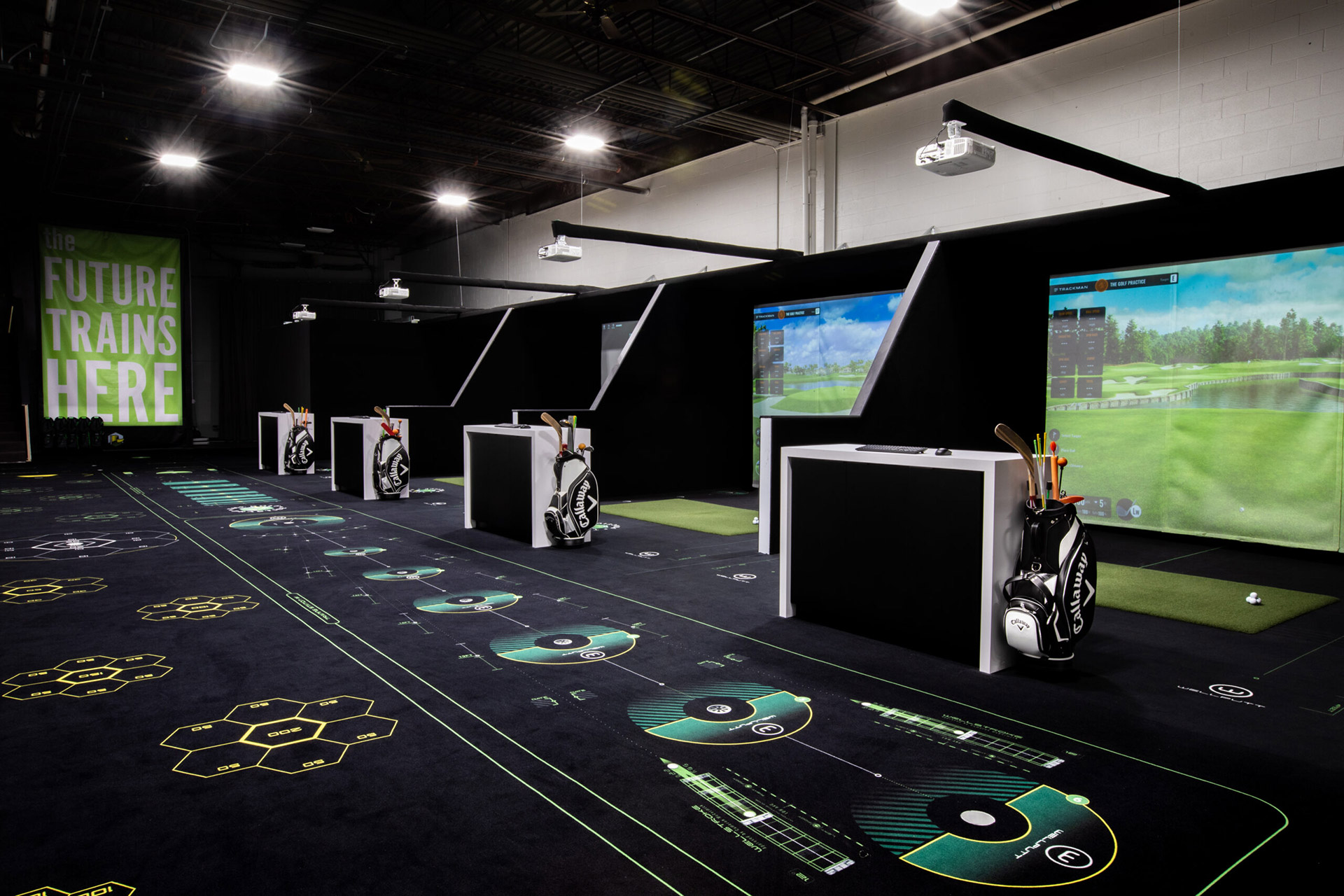

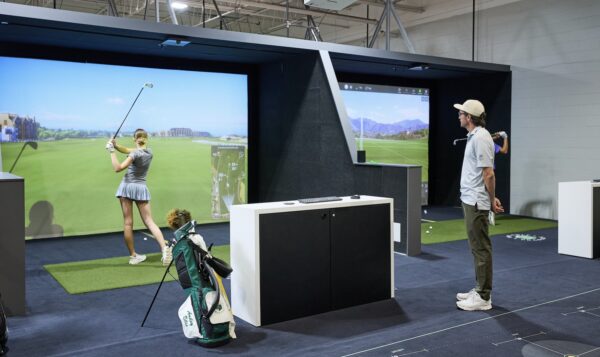
 Walk into The Golf Practice in Highland Park or Lisle, Illinois, and you’ll find both: seven or eight TrackMan simulators running alongside structured coaching programs that use those same simulators as a teaching tool. Most golf facilities force you to choose — either book a lesson or rent a bay. Here, the two work together. But plenty of golfers walk in not fully understanding the difference between unstructured simulator time and actual instruction. Here’s the direct answer.
What a Golf Simulator Actually Does
A simulator does one thing exceptionally well: it gives you immediate, accurate data on what just happened. Ball speed, carry distance, launch angle, spin rate, shot shape — TrackMan captures all of it within milliseconds of impact. For a golfer who knows what they’re looking for, that feedback is genuinely useful. You can work on a specific move, see the data response, and adjust.
The problem is that most golfers don’t know what they’re looking for. A 16 handicapper who slices the ball knows the result. They do not know the face-to-path relationship producing that result, which specific fundamental is driving that relationship, or what to change first. The data is accurate. The interpretation is the hard part — and a simulator alone cannot provide that.
What a Structured Golf Lesson Actually Delivers
A structured lesson at The Golf Practice starts with diagnosis. A coach looks at the same TrackMan data the simulator produces, but they also look at video, at setup, at grip, at ball position. They identify the root cause of the miss — not just the symptom. Then they prescribe a focused correction and track whether the data confirms the change is working.
That’s the key distinction. Simulator time gives you data. A lesson gives you a trained interpretation of the data, a corrective framework, and a documented plan that connects this session to the next one. According to a study from the Journal of Quantitative Analysis in Sports (2020), golfers who received coach-guided feedback alongside technology-based data showed 38% greater measurable improvement over eight weeks compared to those who practiced with the same technology but without instruction. The data tool matters. The coach matters more.
When Simulator Time Is Genuinely Useful
Simulator time earns its place in a training program once a golfer has a specific technical objective they’re working on. If your coach has identified that your club path is running 6 degrees left, and your job this week is to work that number toward 2 degrees left, solo simulator time is excellent. You have a target metric, a clear feel to work on, and immediate feedback confirming whether the change is holding.
It’s also useful for volume. Lessons are typically 30 to 60 minutes. Building a new habit requires significantly more repetitions than a single lesson can provide. Simulator practice between sessions — with a defined objective from your last lesson — is how students at The Golf Practice’s indoor practice membership program convert lesson content into muscle memory. The lesson gives you the objective. The practice time builds the habit.
When a Lesson Is Non-Negotiable
If you haven’t had a diagnostic baseline established, solo simulator time can actively reinforce bad habits. This is the part most golfers underestimate. Repetition without correct direction doesn’t build improvement — it deepens whatever you’re already doing. A golfer who practices 200 swings per week with an undiagnosed swing flaw is practicing that flaw 200 times.
For beginners, this is even more direct: you need instruction first, always. There is no useful solo practice time until you have a fundamental framework to practice within. The Golf Practice’s adult lesson programs — private and group — are designed to establish that framework efficiently before sending students to the simulator to build on it. That sequence matters.
Not Sure Where to Start?
Whether you need a diagnostic lesson or want to combine instruction with unlimited indoor practice time, The Golf Practice has both options at Highland Park and Lisle.
Book Your Lesson or call (847) 850-0956.
How TrackMan Bridges the Gap Between the Two
The reason The Golf Practice runs TrackMan at every simulator bay — rather than a less sophisticated screen golf system — is specifically because the data integrates with the coaching. When a coach sets a session objective for a student and the student goes to practice on their own, the TrackMan data from that practice session tells the whole story. Club path drifted back to old patterns in the last 20 balls? The coach sees it next session and adjusts.
This is not how most simulator facilities operate. Entertainment-focused simulator bars use comparable hardware, but without the coaching framework, the data is essentially decorative. The Golf Practice’s coaching system is built around the assumption that every data point means something — and that the job of a coach is to connect those data points to a coherent improvement plan across sessions, not just within one.
The Right Mix for Different Types of Golfers
For a beginner adult golfer in the Chicago area, the right sequence is clear: start with a lesson or short lesson series to establish fundamentals, then add simulator practice time once you have a technical objective. Trying to learn the game through simulator time alone is like trying to learn to cook by watching a smoke detector — you’ll get a lot of information that tells you something went wrong, but nothing that tells you how to fix it.
For a mid-handicapper (say, 12 to 20 handicap) who already has lessons in their history, the mix shifts. Two or three simulator sessions for every one lesson session is a reasonable ratio, provided each practice session has a defined metric-based goal. Without that goal, the practice time is less productive than it looks. For competitive golfers — juniors in the Mastery 360 program, adults targeting a single-digit handicap — the ratio of structured practice to lesson time becomes part of the coaching plan itself.
What the Research Actually Shows
The golf instruction industry has moved significantly toward technology-based feedback over the past decade, and the results support the shift. A 2021 review in the International Journal of Golf Science analyzed 22 studies on technology-assisted golf instruction and found that launch monitor feedback, when paired with expert coaching interpretation, produced significantly faster skill acquisition than coaching alone or technology alone. The combination is what works. Neither element is sufficient by itself.
This is precisely why The Golf Practice does not offer simulator bay rental as a standalone product disconnected from instruction. The Highland Park and Lisle facilities are built around the idea that technology and coaching are not two separate products — they’re one system. For golfers in Deerfield, Lake Forest, Lisle, Naperville, or anywhere across the northern and western Chicago suburbs, this is what data-driven golf training actually means in practice.
Frequently Asked Questions
Can I improve my golf game just by using a simulator regularly?
If you have clear technical objectives from prior coaching and you’re practicing those specific metrics, yes — simulator time produces real improvement. Without that coaching foundation, regular simulator use tends to reinforce existing patterns rather than correct them. The technology is a practice tool, not a coaching replacement.
How often should I take lessons versus practice on the simulator?
A common starting point for adult golfers working on a specific skill: one lesson per two to three weeks, with two to four solo practice sessions in between each lesson. That ratio gives enough practice time to build the habit while keeping the coaching frequent enough to catch drift before it becomes ingrained. Your coach at The Golf Practice will set the specific plan based on your goals and current skill level.
Do junior golfers benefit from simulator time as well?
Yes, especially once they’re in the 10-and-up range and can meaningfully interpret data. For younger juniors, simulator sessions are typically structured and coach-supervised rather than independent practice. The Golf Practice’s junior programs integrate simulator time as part of the coaching session, not as a separate activity.
What is the difference between a TrackMan simulator and other golf simulators?
TrackMan uses dual-radar technology to track both the club and the ball through the entire swing and flight path. Most consumer simulators use camera-based systems that measure the ball at impact and then project the result. TrackMan’s data — club path, face angle, attack angle, dynamic loft — is what PGA Tour coaches use because it’s the most complete picture of what’s actually happening at impact. That’s why The Golf Practice runs TrackMan at every bay in both locations.
Ready to Get Started?
Whether you’re a first-time golfer who needs a solid foundation or an experienced player ready to practice smarter, The Golf Practice in Highland Park and Lisle has the instruction and the tools to make it happen.
Book Your Lesson or call us at (847) 850-0956.